Symptoms and Care for Dogs With Canine Hereditary Deafness
Your puppy may show signs of congenital deafness if they don’t respond to clapping or squeaky toys by 3 weeks, or don’t wake to loud noises-common in piebald or merle-coated breeds like Dalmatians. Confirm with a BAER test at 5–6 weeks, the only accurate method. Keep your deaf dog safe outdoors using a double leash, fenced yard, bell collar, and microchip. Train with hand signals, vibrating collars, and consistent routines to build confidence, and discover how simple daily adjustments lead to deeper connection and control.
We are supported by our audience. When you purchase through links on our site, we may earn an affiliate commission, at no extra cost for you. Learn more. Last update on 19th July 2026 / Images from Amazon Product Advertising API.
Notable Insights
- Dogs with hereditary deafness often show no response to sounds by 3 weeks, especially in breeds with piebald or merle coats.
- Unilateral deafness may cause a puppy to turn only one ear toward sound, while bilateral cases show no reaction to loud noises.
- BAER testing at 5–6 weeks is the only accurate method to diagnose deafness in each ear.
- Deaf dogs should be kept safe outdoors using fenced yards, double leashes, ID tags, and microchips.
- Train deaf dogs with consistent hand signals, positive reinforcement, and vibration or light cues for attention.
Is Your Puppy Deaf? Signs of Congenital Deafness
How can you tell if your puppy isn’t hearing the world around them? If your puppies have piebald or merle coat patterns-common in Dalmatians, Australian Shepherds, or Bull Terriers-they’re at higher risk for congenital deafness. By 3 weeks, most puppies respond to clapping or squeaky toys; those with hereditary deafness won’t react. Bilaterally deaf puppies don’t wake to loud noises and ignore verbal cues, while unilaterally deaf ones may turn only their good ear toward sound. This lack of hearing function is a red flag for deafness in dogs. Don’t rely on behavior alone-BAER testing at 5–6 weeks offers the only accurate diagnosis. This non-invasive test measures electrical activity in the auditory pathway, confirming whether a puppy is unilaterally deaf or bilaterally deaf. Early detection helps you adjust training, safety, and care for your puppy’s needs.
What Causes Hereditary Deafness in Dogs?
A significant number of dogs with piebald, merle, or mainly white coats carry a genetic predisposition to hereditary deafness, and if your puppy’s coloring includes large areas of white-especially around the face-the risk increases considerably. This form of congenital deafness stems from a genetic defect tied to pigment-related genes, triggering cochleosaccular degeneration. The condition causes progressive atrophy of the cochlear hair cells and supporting tissues in the inner ear soon after birth, leading to permanent canine hearing loss. Dogs with blue eyes and extreme white coat colors are especially prone, as the lack of melanocytes in the inner ear disrupts normal auditory development. Hereditary deafness is typically present by 3 weeks of age, when unaffected puppies begin responding to sound. While it can be unilateral or bilateral, early awareness helps you adapt training and care effectively.
How Is Deafness Diagnosed in Puppies?
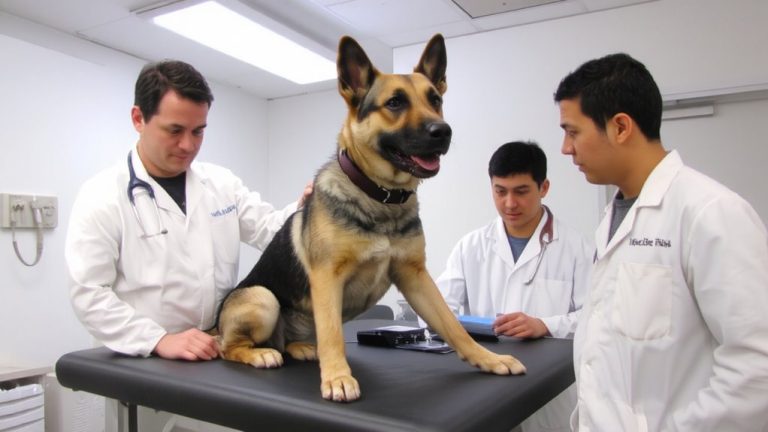
You’ve likely noticed by now if your puppy isn’t reacting to everyday sounds the way littermates do-especially if they’ve got a white, merle, or piebald coat linked to pigment-related deafness. By 3–4 weeks, most puppies respond to noise, but those with congenital deafness cannot hear. To accurately diagnose deafness, the gold standard is the BAER test (Brainstem Auditory Evoked Response), which checks your dog’s ability to process sound via electrodes near the ear.
| Test Type | Detects |
|---|---|
| BAER test | Hearing in each ear |
| Home clapping | Possible deafness |
The BAER test can identify unilateral or bilateral deafness in puppies as young as 5–6 weeks. Breeds like Dalmatians or Australian Shepherds often undergo screening. While home checks help, only a veterinary BAER test can definitively diagnose deafness.
How to Keep Your Deaf Dog Safe Outside
Though they can’t hear approaching cars or your call to come, your deaf dog can still enjoy the outdoors safely with the right precautions in place. Always keep your deaf dog on a double leash during walks-this gives you control near traffic or other Canine disturbances. Confine them to a fully fenced yard with a self-latching gate to prevent escapes. Since your dog’s hearing is absent, attach a small bell to their dog’s collar to track movement by sound, and use a bright ID tag and microchip. Keep in mind that deaf dogs rely on vibration and sight-stomp to alert them. Never assume safety based on ear movement; one ear won’t help. A secure dog’s collar with reflective strips improves visibility. Be consistent: deaf dogs thrive on routine. Even in familiar spaces, always keep vigilant-your attention is their best protection outdoors.
How to Train a Deaf Dog With Hand Signals
Silence isn’t a barrier when it comes to training your deaf dog-visual cues are the key to clear, consistent communication. Start training in a quiet environment to help your deaf dog focus on hand signals without distractions. Use standardized signals, like a flat palm down for “sit” or a sweeping motion toward you for “come,” paired with positive reinforcement such as treats or toys. A vibrating collar or flashing light can grab attention before giving commands, especially outdoors. Consistency with visual cues builds trust and response reliability. Work with a professional trainer experienced in deaf dogs to refine your techniques and strengthen communication. With patience and structured training, your dog will learn quickly and safely. These methods support effective, long-term behavior development and deepen your bond through attentive, visual communication.
Building Routine and Confidence in Deaf Dogs
A consistent daily routine gives your deaf dog a strong sense of security, turning predictability into confidence-knowing when meals happen, when walks start, and when training sessions occur helps them stay calm and engaged throughout the day. Building confidence in deaf dogs relies on clear communication, structured training, and a safe environment. Use hand signals consistently for commands, and reinforce with positive-reinforcement training to boost responsiveness. Visual cues like flashlight signals or vibrating collars support communication, especially at night. Minimize startling by approaching from the front and using foot stomps. These practices enhance emotional well-being.
| Element | Purpose | Example |
|---|---|---|
| Routine | Reduces anxiety | Meals at 7 AM/6 PM |
| Hand signals | Clear communication | “Sit” with flat palm down |
| Visual cues | Alerts and cues | Flashlight for “come” |
| Safe environment | Prevents fear | Soft rugs to muffle steps |
| Structured training | Builds confidence | 10-min sessions, 2x/day |
On a final note
You’ve got this-caring for a deaf dog is absolutely doable with the right tools, like the PetSafe Happy Hoodie for calming walks and consistent hand signals for recall, sit, stay. Use a 6-foot leashed harness for control, train with high-value treats like Zuke’s Mini Naturals, and stick to daily routines. Real testers report strong bond growth, zero behavioral drop-off. With focus, safety, and confidence, your dog thrives.