How to Teach a Newly Adopted Dog Basic Commands in the First Two Weeks
Start training your newly adopted dog on day one with short, 5- to 10-minute sessions using positive reinforcement, high-value treats like freeze-dried liver, and a cheerful tone. Teach “sit” by lifting a treat upward, mark with “yes” the moment their bottom touches down, then say “sit.” Use “down” by luring their nose to the floor, saying the cue as they lie. Build focus with “stay” after mastery of “sit,” using a release word like “OK,” and practice “leave it” by covering a treat and rewarding when they turn away. Train recall in quiet spaces like your kitchen-call their name followed by “come,” then reward instantly with a treat. Use a 6-foot leash for loose-leash walking, reward at your hip, stop if they pull, and change direction to regain attention. Real progress happens with consistency, and there’s more where that came from.
We are supported by our audience. When you purchase through links on our site, we may earn an affiliate commission, at no extra cost for you. Learn more. Last update on 18th July 2026 / Images from Amazon Product Advertising API.
Notable Insights
- Start training immediately using positive reinforcement with treats and praise to build trust and encourage learning.
- Focus on one command like “sit” using a treat lure, mark the behavior, and keep sessions under 10 minutes.
- Teach “down” by guiding the dog’s nose to the floor with a treat, saying “down” as they lie.
- Introduce “stay” after “sit” is reliable, reward stillness, and use a consistent release word like “OK.”
- Practice recall in quiet indoor areas, call the dog cheerfully, and reward instantly with high-value treats.
Start Puppy Training on Day One With Positive Reinforcement
While your newly adopted puppy may still be adjusting to their surroundings, starting training on day one with positive reinforcement sets the foundation for a confident, well-behaved companion. When you teach your newly adopted dog early, you build trust fast. Training your new puppy using treats in hand and verbal praise strengthens good behavior instantly. Keep sessions short-just 5 to 10 minutes-so your pup stays focused and enthusiastic. Use high-value treats like freeze-dried liver to reinforce basic commands quickly. Start puppy training on day one by focusing on one cue, like “sit,” to avoid confusion. Always rely on positive reinforcement; never use punishment-based methods, which can cause fear, especially in rescue dogs. Reward immediately after the correct action. With consistency, short training sessions, and cheerful encouragement, your puppy learns faster and feels safer.
Teach “Sit” and “Down” Using Treats and Timing
You’ve already started building trust with your new puppy using positive reinforcement, and now you can put that momentum to work teaching two foundational commands: “sit” and “down.” Begin with “sit” by holding a high-value treat like Zuke’s Mini Naturals right in front of your pup’s nose, then slowly lift it straight up so their head follows the treat and their bottom naturally lowers to the ground. As soon as they sit, mark with “yes” and give the treat-timing is key. For “down,” lure with your hand, guiding the treat from nose to floor, encouraging your puppy to follow the treat into a full body stretch. Reward immediately when they lie down. Use the hand motion consistently so your puppy links the action with the command.
| Command | Cue Timing |
|---|---|
| Sit | Say “sit” as bottom nears floor |
| Down | Say “down” after they follow the treat |
| Reward | Treat within 1 second |
| Hand | Move slowly, palm up |
| Training | 5–10 min, multiple times daily |
Build Focus With “stay” and “Leave It
What if your dog could stay put on command, even with distractions around? Start teaching the stay command only after your dog reliably sits, using a consistent release word like “OK” to mark when movement’s allowed. Build focus by rewarding stillness for a few seconds at first-silently count to track duration. Gradually increase the distance by stepping back, then returning fast to reward. Practice the command daily, extending steps as your dog improves. For “leave it,” hold your hand over a treat, waiting until your dog’s nose turns away before rewarding with a different treat. Say “leave” calmly when they ignore the closed fist. Progress to a treat on the floor, covering it, then hovering your hand six inches above. End each session on a positive note.
Train Reliable Recall in Low-Distraction Settings
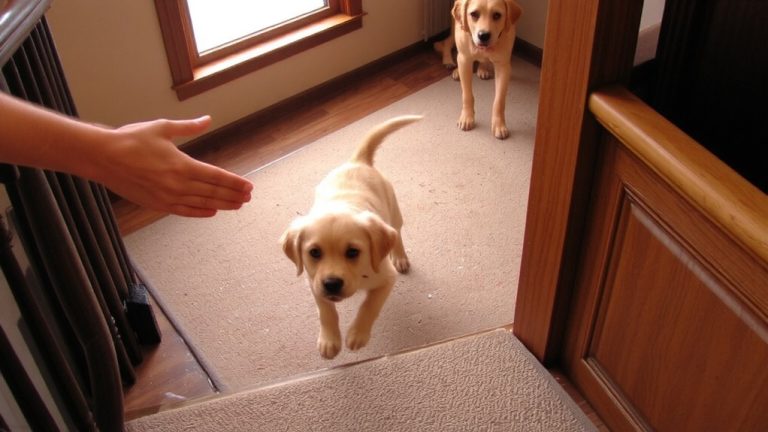
If your newly adopted dog hasn’t yet mastered coming when called, starting in a quiet indoor space like a bathroom or kitchen gives you the best shot at building a strong, reliable recall, especially with a 9-month-old pit mix like Rubble who’s still learning the rules. Begin recall training in low-distraction settings by calling Rubble’s name followed by the “come” command in a bright, cheerful tone. Reward him immediately with a high-value treat when he responds. Use a leash to gently guide him if he hesitates. Keep sessions short-just 5 to 10 minutes-and practice daily, gradually increasing distance from 3 to 6 feet. Always end on a positive, ensuring each session builds confidence. Consistent practice in low-distraction settings strengthens reliability, making future outdoor training far more successful.
Practice Loose-Leash Walking From the First Walk
| Step | Action | Outcome |
|---|---|---|
| 1 | Attach collar & 6-foot leash | Pup feels leash tension |
| 2 | Say “let’s go” | Begins loose-leash walking |
| 3 | Offer treat reward at hip | Reinforces correct position |
| 4 | Stop if pulling | Encourages attention |
| 5 | Change direction | Teaches self-correction |
On a final note
You’ve got this-start training on day one with treats, timing, and praise. Use small, soft treats (like Zuke’s Mini Naturals) every 3–5 seconds to reinforce “sit,” “down,” “stay,” and “leave it.” Practice recall in quiet spaces, then gradually add distractions. Keep walks calm with a front-clip harness and 6-foot leash. Consistency, patience, and positive reinforcement build trust, focus, and good behavior fast.